Friday, June 30, 2023

Book Review: Appointment in Bath by Mimi Matthews

A chance meeting between the sheltered daughter and the forward-thinking son of rival Victorian families sparks a forbidden romance in USA Today bestselling author Mimi Matthews’s fourth book in her acclaimed Somerset Stories series. 

Shy and stammering Meg Burton-Smythe has spent the whole of her life living on the fringes of local society. She’s more comfortable with her daydreams than she is with people. But when a dashing, golden-haired hero rides to her rescue one morning, she dares to hope that her dreams might finally come true. There’s only one problem: her handsome rescuer is the son of her father’s sworn enemy. 

Ivo Beresford doesn’t believe in clinging to the past. Freshly returned from a lengthy grand tour, he’s looking to the future, eager to spearhead the building of a new railway extension in Somersetshire. But an unexpected encounter with Meg Burton-Smythe, the isolated only daughter of his parents’ oldest foe, sets the past and the future colliding. 

Resolved to put ancient grudges to rest—at least where innocent young ladies are concerned—Ivo encourages lonely Meg to embark on a secret friendship. After all, what harm can a friendship do? It isn’t as though there’s any danger of the two of them falling in love…


Within Mimi Matthews’ fourth title in the Somerset Stories series, readers will find the shy, faltering and beautiful Margaret “Meg” Burton-Smythe. At the youthful age of eighteen she is untried in the ways of the world, yet she is eager to make her debut in society as a gentleman’s daughter. As a sheltered young woman, she has a lively imagination, fueled by copious reading while living a quiet life on her father’s country estate. This fosters a longing for success not only on England’s marriage mart, but also for success in finding a chivalrous hero with whom she would fall in love. She faces several relational challenges in this diverting narrative, not the least of which is the veritable Shakespearian rivalry between her father and the nearby Beresford family. This decades-long feud is not unwarranted, but is a festering wound within the community. Meg befriends one of the Beresford sons, which leads to emotional confrontations on both sides.

Although Appointment in Bath is the fourth title in the Somerset Stories series, this reviewer has not read the previous two volumes. Thus far I have enjoyed Matthews’s title The Work of Art, the opening novel of this collection. With the publication date of Appointment in Bath occurring the week of this writing, I wanted to be a part of promoting this latest story. Although it was a bit of a risk to temporarily skip over Gentleman Jim and Return to Satterthwaite Court, I was nonetheless rewarded with a delightful tale. There are some references to those prior works, but Appointment in Bath works quite well as a standalone.

Mimi Matthews’s work is a pure delight. Her writing skill enables her to craft a compelling story, present well-drawn characters and avoid predictability in her choices. While much of her writing is firmly set in the 19th century, she presents characters who are relatable and accessible. The protagonists are likable, and the villains earn this reader’s disdain. She doesn’t avoid addressing difficult and gritty issues, but the content is not salacious or gratuitous. Mature themes are addressed in a realistic yet modest way. The romantic moments are simply delicious and leave the audience wanting more without drawing us deep into the minutiae of bedroom scenes. I loved the friendship of Meg and Ivo, and my heart broke for her as she yearned for more love and affection from her father. 

While Appointment in Bath does offer a satisfying, realistic conclusion, not every difficult issue is tied with a neat little bow. Characters face challenges that are common to many in our non-fictional, modern existence. Some readers may easily identify with Meg’s stuttering problem, her struggles with anxiety, and her growth as a young woman. Others will relate to Ivo as he works to improve his community in the face of a local township that is resistant to modernization. Between the characters’ ambitions, family conflicts, desires for reconciliation and romantic endeavors, Appointment in Bath offers an absorbing narrative that was thoroughly enjoyable. Due to Matthews’ excellent work in this as well as the opening novel The Work of Art, I look forward to retracing my literary steps in order to also read the other books in this series, Gentleman Jim and Return to Satterthwaite Court. A fifth title, A Lady of Conscience is also due for publication in June of 2024. Mimi Matthews continues to show herself to be a reliable and entertaining author, one who consistently earns my hearty endorsement.  


Hollywood Casting

As I read Appointment in Bath, I kept in mind several actors who could play the parts of Mimi's characters. While I didn't "cast" everyone in the novel, these mental images help me organize some of the personalities in my head.  Regardless of their current ages or nationalities, my imagination placed them at their ages in the story, with corresponding cultural accents when they spoke.


Would you like a sample of Appointment in Bath? Click HERE to read Chapter One!


About the Author

USA Today bestselling author Mimi Matthews writes both historical nonfiction and award-winning Victorian romances. Her novels have received starred reviews in
Publishers Weekly, Library Journal, Booklist, Kirkus, and Shelf Awareness, and her articles have been featured on the Victorian Web, the Journal of Victorian Culture, and in syndication at BUST Magazine. In her other life, Mimi is an attorney. She resides in California with her family, which includes a retired Andalusian dressage horse, a Sheltie, and two Siamese cats.


The Somerset Stories Series


Paperback

Kindle

Audio
Paperback

Kindle

Audio
Paperback

Kindle

Audio
Paperback

Kindle

Audio

Saturday, June 17, 2023

Book Review: A Shadow in Moscow by Katherine Reay

In the thick of the Cold War, a betrayal at the highest level risks the lives of two courageous female spies: MI6’s best Soviet agent and the CIA’s newest Moscow recruit.

Vienna, 1954

After losing everyone she loves in the final days of World War II, Ingrid Bauer agrees to a hasty marriage with a gentle Soviet embassy worker and follows him home to Moscow. But nothing within the Soviet Union’s totalitarian regime is what it seems, including her new husband, whom Ingrid suspects works for the KGB. Inspired by her daughter’s birth, Ingrid risks everything and reaches out in hope to the one country she understands and trusts—Britain, the country of her mother’s birth. She begins passing intelligence to MI6, navigating a world of secrets and lies, light and shadow.

Moscow, 1980

A student in the Foreign Studies Initiative, Anya Kadinova finishes her degree at Georgetown University and boards a flight home to Moscow, leaving behind the man she loves and a country she’s grown to respect. Though raised by dedicated and loyal Soviet parents, Anya soon questions an increasingly oppressive and paranoid regime at the height of the Cold War. Then the KGB murders her best friend and Anya chooses her side. Working in a military research lab, she relays Soviet plans and schematics to the CIA in an effort to end the 1980s arms race.

The past catches up to the present when an unprecedented act of treachery threatens all agents operating within Eastern Europe, and both Ingrid and Anya find themselves in a race for their lives against time and the KGB.


Beginning with her 2013 debut novel Dear Mr. Knightley, author Katherine Reay’s work was firmly planted in the Austenesque community for some time. She showcased her love for and knowledge of Jane Austen’s characters with several winsome titles which delighted many. In recent years I noted that she began branching out into other areas of storytelling with much continued success. Her latest novel, A Shadow in Moscow held an intriguing premise, and I was pleased to have the opportunity to read and review it for its Austenprose blog tour. 

It has been the better part of a decade since I’ve read a Reay title and in that time she has thoroughly honed her craft. As such, my experience with A Shadow in Moscow felt very fresh and was very different from my time with Dear Mr. Knightley. While there are a few minor references to Austen in the novel, this is a Cold War spy novel, through and through. Told with dual timelines, readers are taken into the secret and complex lives of two female spies as they navigate the intricacies of life under the gaze of the KGB. Ingrid and Anya love the land in which they live, but want more for the people of Russia than the oppression under which they are living. As cogs in an elaborate machine working to make the world a better place, these strong women make similar decisions while living in separate generations. Eventually their storylines begin to merge, but in general the plot alternates between the narratives of the two women to delicious effect. 

Katherine Reay’s research and dedication to the subject matter of Soviet history and spycraft is deep and meticulous throughout A Shadow in Moscow. The level of expertise she exhibited in her writing was truly impressive, and the education she most certainly received while preparing for this work can be respected at the highest levels. While I am no Russian historian or specialist in the world of espionage, the level of realism that Reay captured was astounding. Immersive and seemingly accurate, A Shadow in Moscow also features extremely well-drawn characters, a compelling plot and satisfying conclusion. The adult material that must be addressed when dealing with this time period and culture is handled carefully, yet difficult scenes and topics are not avoided. Reay’s writing is skillful enough to convey heartbreaking tragedy and mature themes without gratuitous detail. I not only appreciated her discretion, but also her willingness to address the dark underbelly of the world in which her characters inhabited. 

The only slight “hiccup” I had in reading A Shadow in Moscow came through the alternating timeline. As the focus alternated between the characters of Ingrid and Anya, this aided in keeping my attention for the most part. However, there were a few times wherein their similar struggles as spies in the Russian culture were similar enough that I occasionally lost track of which plot points had occurred with which character. This was not a huge problem, and does not detract from my hearty endorsement of the book. 

I came to read A Shadow in Moscow because of the delightful Katherine Reay, but also due to the premise of the novel. The expectations of an intriguing, exciting and satisfying story were well met. I loved the occasional references to authors such as Jane Austen, Leo Tolstoy and Harper Lee, which have made me want to pull out my copies of works like Anna Karenina all over again. 

Tidbits of philosophy were also woven throughout the narrative, and one thought in particular has truly resonated with me. Many of the characters in A Shadow in Moscow were dealing with immense oppression. Ingrid does her best to rise above her situation not by escaping it, but by changing her attitude towards it. This alters her “internal landscape”, and through that adjustment she is able to face even the harshest trials. She carries a human dignity which she endeavors to share with the world. Like Ingrid, Anya also holds admirable ideals when she says in chapter fourteen, “I wanted to do everything I could to make the world a better place, one that honored the dignity of humans and allowed each and every person to thrive.” (p. 176) That is the essence of A Shadow in Moscow in a nutshell. It is certainly a Cold War spy novel, but it also conveys a message of resilience and hope to humanity in search of Light. Author Katherine Reay has crafted a fine work and should be congratulated for her achievement.


About the Author


Katherine Reay is a national bestselling and award-winning author who has enjoyed a lifelong affair with books. She publishes both fiction and nonfiction, holds a BA and MS from Northwestern University, and currently lives outside Chicago, Illinois, with her husband and three children.


Tuesday, May 23, 2023

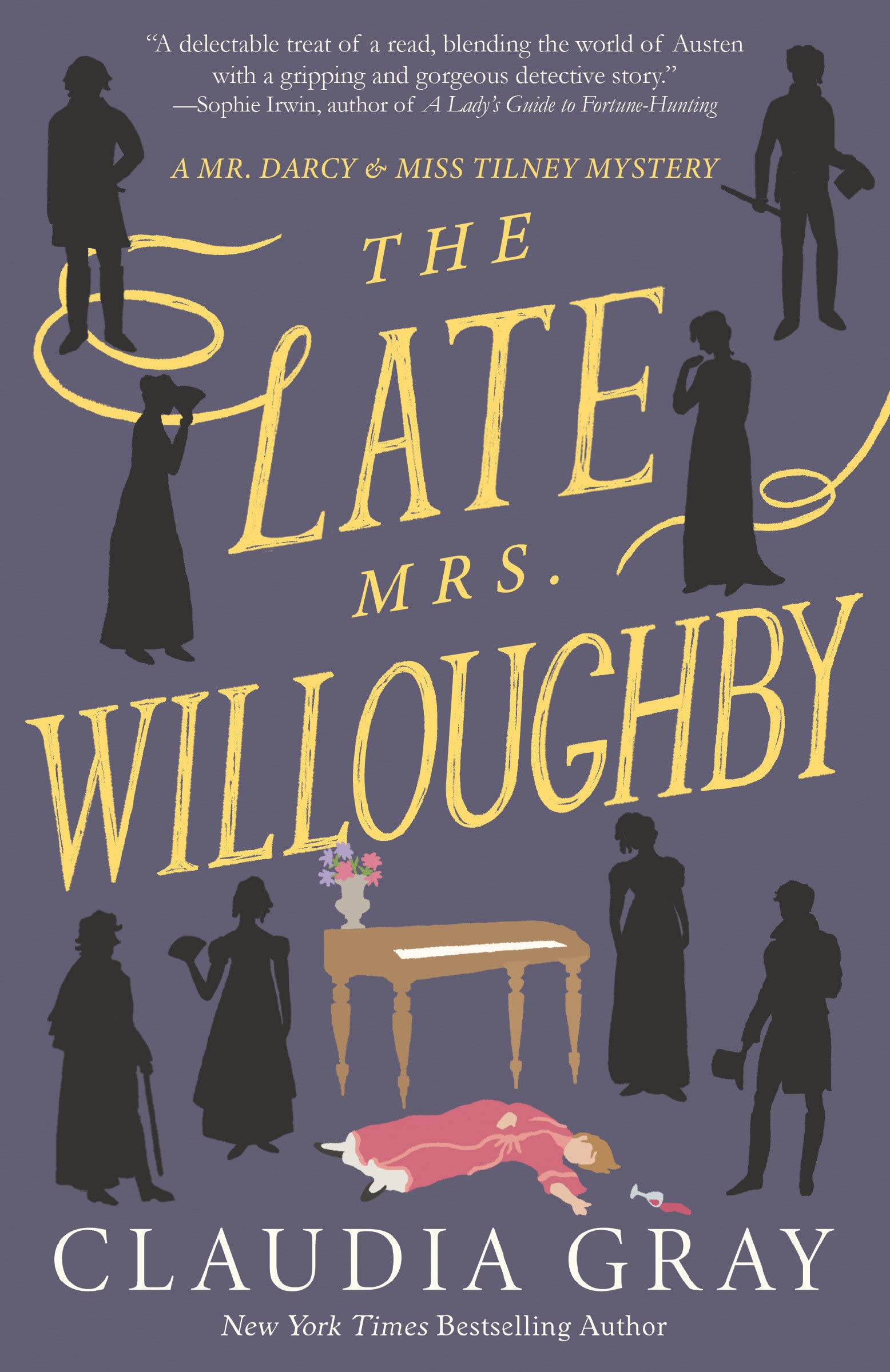
Book Review: The Late Mrs. Willoughby by Claudia Gray

The suspenseful sequel to The Murder of Mr. Wickham, which sees Jonathan Darcy and Juliet Tilney reunited, and with another mystery to solve: the dreadful poisoning of the scoundrel Willoughby's new wife.

Catherine and Henry Tilney of Northanger Abbey are not entirely pleased to be sending their eligible young daughter Juliet out into the world again: the last house party she attended, at the home of the Knightleys, involved a murder—which Juliet helped solve. Particularly concerning is that she intends to visit her new friend Marianne Brandon, who's returned home to Devonshire shrouded in fresh scandal—made more potent by the news that her former suitor, the rakish Mr. Willoughby, intends to take up residence at his local estate with his new bride.

Elizabeth and Fitzwilliam Darcy of Pemberley are thrilled that their eldest son, Jonathan—who, like his father, has not always been the most socially adept—has been invited to stay with his former schoolmate, John Willoughby. Jonathan himself is decidedly less taken with the notion of having to spend extended time under the roof of his old bully, but that all changes when he finds himself reunited with his fellow amateur sleuth, the radiant Miss Tilney. And when shortly thereafter, Willoughby's new wife—whom he married for her fortune—dies horribly at the party meant to welcome her to town.

With rumors flying and Marianne—known to be both unstable and previously jilted by the dead woman's newly made widower—under increased suspicion, Jonathan and Juliet must team up once more to uncover the murderer. But as they collect clues and close in on suspects, eerie incidents suggest that the killer may strike again, and that the pair are in far graver danger than they or their families could imagine.


A year ago the Austenesque community was given a delightful read in Claudia Gray’s The Murder of Mr. Wickham. Within this cozy mystery many characters from the mind of Jane Austen were given new life, and original individuals were brought to the literary stage as well. The most notable of the fresh faces were drawn from Austen’s Northanger Abbey and Pride and Prejudice. Juliet Tilney is the daughter of Northanger Abbey’s Henry and Catherine. She is joined by Jonathan Darcy, son of the Darcys of Pemberley in Pride and Prejudice. Both of these young people proved to be an effective team as the mystery of the death of George Wickham was worked out in The Murder of Mr. Wickham. In this sequel they have been reunited, and once again are witnesses to a suspicious death. The wife of Sense and Sensibility’s John Willoughby, Sophia Willoughby, suddenly dies of poisoning while in the presence of several witnesses and suspects. Jonathan and Juliet work diligently to determine the identity of those who might be at fault in the case. They are not only motivated by a sense of curiosity, but also by a desire to see justice done. Without their efforts, a blameless friend may be accused of the crime. 

Author Claudia Gray has again crafted a delightful mystery with beloved characters which are both fresh from her imagination and well-established from Austen. While the death of Sophia Willoughby is a dramatic one, the circumstances surrounding it are completely plausible. Mrs. Willoughby is presented as a distasteful woman, married to a man already known to be of questionable integrity. Any number of people could be enemies to the Willoughbys, and readers are kept guessing throughout the narrative. Claudia Gray offers quite a few red herrings, and while this reader was able to eliminate several suspects from the outset, I never truly saw who was to blame until the very end. The culprit(s) was/were completely unexpected, yet utterly believable as well. The finale held stunning and creative choices. The Late Mrs. Willoughby was familiar in tone, but never predictable. In this regard it was literary comfort food and a surprise dish, all in one. 

Although The Late Mrs. Willoughby is firmly a cozy mystery, I commend Claudia Gray for exploring ancillary issues as well. As was presented in the first novel, Jonathan Darcy is a neurodivergent personality. A modern diagnosis might reveal some type of sensory disorder, or perhaps autism-spectrum issues. He struggles to understand social cues, is highly intelligent and sometimes has trouble with particular sensory influences. These factors are all too real to many families in the 21st century, and it is interesting to see how Jonathan’s condition manifests within 19th century English society. I found his character to be utterly endearing, especially as I am a family member of persons with similar issues. Including this type of character within the novel is unique and appreciated.

Gray also explores other themes which are attached to the mystery. Marianne Brandon seems to be suffering from significant post-traumatic stress in the wake of the events seen in the previous novel. Edward Ferrars struggles with forgiveness and reconciliation within his extended family. Colonel Brandon’s ward, Beth Williams yearns to find her place in the world as an illegitimate daughter and unwed mother herself. While The Late Mrs. Willoughby is an enjoyable mystery, deeper issues are woven throughout and lend a measure of substance to it.

Because The Late Mrs. Willoughby is a sequel, there are quite a few references to the previous title, The Murder of Mr. Wickham. The second work could be read on its own, but the enjoyment would be diminished significantly if read in such a way. Wickham is also an enjoyable read, so it is certainly recommended that both are read in succession. Jonathan Darcy and Juliet Tilney make a great sleuthing pair, and elements near the conclusion of this novel seem to indicate that their work together is not yet complete. At ages 21 and 17 (respectively), Jonathan and Juliet are quite young and could have many years ahead and scores of adventures together. This romantic also hopes that their friendship will continue to grow, and perhaps one day we will find them in the position that Austen often placed her main characters, standing before the altar to begin their Happily Ever After.


AUTHOR BIO


Claudia Gray is the pseudonym of Amy Vincent. She is the writer of multiple young adult novels, including the Evernight series, the Firebird trilogy, and the Constellation trilogy. In addition, she’s written several Star Wars novels, such as Lost Stars and Bloodline, and Jane Austen-inspired series, A Mr. Darcy & Miss Tilney Mysteries. She makes her home in New Orleans with her husband Paul and assorted small dogs. 


Paperback

Kindle


Wednesday, April 19, 2023

Book Review: Brother of the Bride by Jack Caldwell

A sequel to Pride and Prejudice and The Three Colonels.

In 1816, everyone thinks—with the Napoleonic wars over and done—that life in England will be peaceful. Not necessarily.

For four wonderful years, Fitzwilliam Darcy has joyfully lived at his beloved Pemberley with his adored wife, Elizabeth, precious young son, Bennet, and cherished sister, Georgiana, by his side. All this is about to change; Georgiana has fallen in love. In quick succession, the Darcys agree to take in the young and spirited daughter of the widowed Lydia Wickham and then learn that Elizabeth is expecting another child.

Now—with a wedding to plan, a baby on the way, interfering relations invading Pemberley, and a new ward turning the place upside down—the question becomes: How will Mr. Darcy maintain his sanity?


For many years I have enjoyed the work of Austenesque writer Jack Caldwell. His “Fighting Men” series began with The Three Colonels in 2012, and with Brother of the Bride's release, five titles are now available. All are sequels to novels originated by Jane Austen, with Pride and Prejudice being the dominant source material. In Caldwell’s world, the Darcy family interacts with characters throughout the Austen universe. For example, Colonel Brandon from Sense and Sensibility is a dear friend to the Darcys, and several individuals from Emma are also a part of their lives. As strong men and women of their time, this unique cast of characters has encountered trials on the battlefield and open sea. Now in Brother of the Bride, Fitzwilliam Darcy and his associates must face challenges both familiar and untried: the birth of a child, the fostering of another, and the marriage of young Georgiana Darcy.

The audience of Brother of the Bride is most certainly a specific type. We are familiar with not only the works of Jane Austen, but of Caldwell’s series as well. This latest title does have an individual tone, but many details hinge upon what has come before, both in the original works and in the “Fighting Men” collection. While its narrative arc does not have the same scope as its siblings, Brother of the Bride is a treat for those of us who call ourselves “Janeites”. In the pages of this novel we are immersed in what would have been the everyday inner workings of the Darcy family and their associates. There is no Napoleon to vanquish or damsels to rescue from certain peril on the sea. Trials and tribulations emanate from domestic concerns which many of us must face at one time or another. 

When young Georgiana Darcy becomes engaged to be married, it creates a tangle of issues which the characters must unravel as they also face other variables. Elizabeth Darcy is pregnant again, and due to give birth near the time of Georgiana’s preferred wedding date. Lizzy’s flighty sister Lydia has entrusted the care of her daughter Chloe to the Darcy family. Chloe is a handful and makes life interesting within the Pemberley estate. And with the engagement of Georgiana, all manner of relatives and friends step forward to “assist” in planning the nuptials. Between Lizzy’s pregnancy, Chloe’s antics and issues surrounding the wedding, Fitzwilliam Darcy and his ilk are juggling challenges that would confound even the most talented battlefield warrior. It makes for an amusing read. 

As he has done in the past, author Jack Caldwell has deftly woven together the characters of the novels of Jane Austen. The material is very family friendly, with very little “adult” content of note. Romance is chaste, and all bedroom scenes are between married partners, with modest details given. The most “vexing” aspect of the story are the antics which ensue when elder stateswomen attempt to meddle with the wedding plans. Those of us who have arranged a wedding might have flashbacks to the stress involved in that endeavor, but the episodes in Brother of the Bride are quite amusing and meant to entertain. It was refreshing to see family members stand up to the austere Lady Catherine de Bourgh as she attempted to mistake her place in the order of things. Mrs. Bennet was as high-strung as ever and also had to be reined in from time to time. 

As a fan of these characters, I felt as if I was a mere observer to the realistic goings-on at Pemberley as life continued. Again, this was no expansive narrative. It was a delightful visit with and a character study of the personalities who have become permanent residents in the minds of those who love them. Through Brother of the Bride we see Fitzwilliam Darcy, his family and friends as they interact during a new period of their lives. This season brings with it relational tangles which must be unraveled, but it also brings much joy and celebration as well. Author Jack Calwell is to be applauded for this latest work in his Austenesque library. Brother of the Bride is a pleasure for those who cherish these beloved characters.


About the Author


Jack Caldwell, born and raised in the Bayou country of Louisiana, is an author, amateur historian, professional economic developer, playwright, and like many Cajuns, a darn good cook.

Jack is the author of twelve Jane Austen-themed historical romances. PEMBERLEY RANCH is a retelling of Pride & Prejudice set in Reconstruction Texas. MR. DARCY CAME TO DINNER and THE COMPANION OF HIS FUTURE LIFE are Pride & Prejudice-flavored farces. 

THE THREE COLONELS, the first of his JANE AUSTEN’S FIGHTING MEN SERIES, is a sequel to Pride and Prejudice and Sense and Sensibility. The next two books in the series are companion novels: THE LAST ADVENTURE OF THE SCARLET PIMPERNEL, a cross-over of Northanger Abbey with The Scarlet Pimpernel, and PERSUADED TO SAIL, a sequel to Persuasion. BROTHER OF THE BRIDE is a sequel to Pride and Prejudice and THE THREE COLONELS. ROSINGS PARK is the conclusion to the series.

In 2015, he released the first four of a series of historical novels about New Orleans, titled THE CRESCENT CITY SERIES. THE PLAINS OF CHALMETTE begins the series, commemorating the Bicentennial of the Battle of New Orleans. Jack marked the tenth anniversary of Hurricane Katrina with three modern novels: BOURBON STREET NIGHTS, ELYSIAN DREAMS, and RUIN AND RENEWAL.

When not writing or traveling with his wife, Barbara, Jack attempts to play golf. A devout convert to Roman Catholicism, Jack is married with three grown sons. Jack’s blog postings—The Cajun Cheesehead Chronicles—appear regularly at Austen Variations.


Website  |  Blog  |  Facebook  |  Twitter  |  Goodreads


Thursday, April 6, 2023

Review: The Jaipur Trilogy by Alka Joshi


I began reviewing books in 2009. For the first time in almost fourteen years I am offering an extended critique of three volumes in one post. The Jaipur Trilogy has garnered rave reviews within the literary community, and they are well deserved. Alka Joshi’s work is a treasure, and I am officially a fan. If you’d like an extended elaboration of this endorsement, settle in for a long read below.


The Henna Artist

Publisher Description:

Vivid and compelling in its portrait of one woman’s struggle for fulfillment in a society pivoting between the traditional and the modern, The Henna Artist opens a door into a world that is at once lush and fascinating, stark and cruel.

Escaping from an abusive marriage, seventeen-year-old Lakshmi makes her way alone to the vibrant 1950s pink city of Jaipur. There she becomes the most highly requested henna artist—and confidante—to the wealthy women of the upper class. But trusted with the secrets of the wealthy, she can never reveal her own…

Known for her original designs and sage advice, Lakshmi must tread carefully to avoid the jealous gossips who could ruin her reputation and her livelihood. As she pursues her dream of an independent life, she is startled one day when she is confronted by her husband, who has tracked her down these many years later with a high-spirited young girl in tow—a sister Lakshmi never knew she had. Suddenly the caution that she has carefully cultivated as protection is threatened. Still she perseveres, applying her talents and lifting up those that surround her as she does.


My Thoughts:

I was completely taken in by The Henna Artist. Indian culture is quite foreign to me, yet I find it fascinating. Alka Joshi’s writing not only made the setting accessible to this reader, but she elevated my understanding of the country and the era in which the story was placed. Her descriptions were lush without being overindulgent, and the character development caused me to truly care about the players within the novel. Main protagonist Lakshmi is an impressive woman, as she has had to fend for herself for many years within a culture that presented many obstacles to success. Through her talents and ability to relate to others, she maneuvers her way through society to find favor with the royal elite and powerful alike. Even when she encounters unexpected turns along her journey, she finds ways to persevere and make something of herself. Joshi’s narrative was thoroughly unpredictable, delightful, tragic and touching in so many ways. It was a pleasure to read.

While I found The Henna Artist to be a compelling treasure, there are moments that are difficult within Lakshmi Shastri’s story. Issues surrounding the topic of abortion are raised from time to time. As someone who does not support abortion and has experienced pregnancy loss, I found some events to be heartbreaking. That said, The Henna Artist shines a light on the plight that many women faced in the 1950s and most certainly face today. My views on abortion were not changed in reading about these women, but my perspective on the subject was deepened. This arena is a complex tangle of problems and tragedy. While I firmly value the sanctity of life from the point of conception, I also believe we need to have compassion for those who see no other choice than to end their pregnancies. 

In response to those who may be concerned about this difficult element in The Henna Artist, it can also be noted that the alternative of adoption is a strong theme in the narrative as well. In fact, one adoption in particular is what sustains the narrative arc of the entire trilogy until the conclusion in The Perfumist of Paris.

As the title indicates, Lakshmi is most known for her work as a henna artist, and this remains the primary focus of her career. Through her talents she is able to build a new life in Jaipur, and she also begins to fashion a new family as well. Themes of redemption, ingenuity and love are strong throughout her story, with moments of levity that shaped an unforgettable novel that I will cherish for years to come. The Henna Artist has been a rousing success for debut author Alka Joshi, and it is well deserved.


The Secret Keeper of Jaipur

Publisher Description:

In New York Times bestselling author Alka Joshi’s [The Secret Keeper of Jaipur], henna artist Lakshmi arranges for her protégé, Malik, to intern at the Jaipur Palace in this tale rich in character, atmosphere, and lavish storytelling.

It’s the spring of 1969, and Lakshmi, now married to Dr. Jay Kumar, directs the Healing Garden in Shimla. Malik has finished his private school education. At twenty, he has just met a young woman named Nimmi when he leaves to apprentice at the Facilities Office of the Jaipur Royal Palace. Their latest project: a state-of-the-art cinema.

Malik soon finds that not much has changed as he navigates the Pink City of his childhood. Power and money still move seamlessly among the wealthy class, and favors flow from Jaipur’s Royal Palace, but only if certain secrets remain buried. When the cinema’s balcony tragically collapses on opening night, blame is placed where it is convenient. But Malik suspects something far darker and sets out to uncover the truth. As a former street child, he always knew to keep his own counsel; it’s a lesson that will serve him as he untangles a web of lies.


My Thoughts:

While The Henna Artist centers on the life, ambitions and relationships of Lakshmi Shastri, The Secret Keeper of Jaipur has a different feel. The tone is almost like a political or corporate thriller, with elements of mystery and subterfuge within the circles of Jaipur’s high society and government. Much attention is given to Lakshmi’s dear friend Malik, whom readers meet in The Henna Artist as a boy who is struggling to survive on the streets. In this novel he is now a young man who is coming into his own as an apprentice with the Jaipur Palace Facilities Office. 

The narration alternates between Lakshmi, Malik, and a young widow named Nimmi who lives outside the city. Their lives are interconnected in different ways, each facing challenges as individuals and within their mutual relationships. Many characters from The Henna Artist make appearances, some of whom hold secrets which have dire consequences if they are revealed. Malik shows himself to be a young man of integrity, and not everyone is sympathetic to his views. This makes for riveting reading as he navigates the world of business, construction and politics. 

While The Secret Keeper of Jaipur has a slightly different tone than its predecessor, it remains a highly enjoyable novel. I appreciated the alternating viewpoints of the narrators, and Alka Joshi’s prose once again drew me into the world of 20th century India. Lakshmi’s role has shifted a bit, as she spends more time as a medical healer and helping with issues that arise with Malik and Nimmi. The significant adoption that occurs in The Henna Artist has its repercussions in Lakshmi’s life as well, and she has to manage developments stemming from that. The many threads of the narrative are woven in a way that is captivating, colorful and creative. Alka Joshi showed no evidence of a sophomore slump in this second part of her sweeping trilogy.


The Perfumist of Paris

For this third volume I am not offering the publisher’s description. There are some elements within that blurb that were unknown to me when I began to read The Perfumist of Paris, and that ignorance was to my benefit. Readers can easily go to other sources if they are eager for that content. As a general summary, I will offer a more basic description. As the title indicates, the setting for the novel is Paris, France. The year is 1974, and Lakshmi’s younger sister Radha is now a grown woman with a family of her own. Like many women of that era, she is juggling the demands of traditional marriage, motherhood and a career. She is also burdened by secrets from her past, which she has kept hidden from almost everyone. While on a business trip to India she not only finds the key to what she’s been searching for in a work assignment, but she discovers that her secrets will not be hidden for much longer. A time of reckoning has been thrust upon her, and decisions must be made. 

Although mostly set in Paris, this third title in the trilogy has a tone that is similar to The Henna Artist. The plot is very character-driven and follows the actualization of a young woman who is also trying to make her way in the world. There is less subterfuge than in The Secret Keeper of Jaipur, but Radha’s secrets have significant consequences in her life. Author Alka Joshi’s writing continues to be enthralling. Fans of the Netflix program Emily in Paris will find several elements in common with this novel, which is an asset. The individuals with whom Radha interacts are distinct and well-drawn. Her French as well as Indian relationships were contrasting in many ways, and I found them to be interesting and realistic. 

Although the time period is set many decades ago, I didn’t feel alienated from their issues. In some senses much has changed since the 1970s, but it remains true today that men and women alike struggle with the home-work life balance. It’s possible to “want it all” in the area of love, career and family, but there are limits to each arena. Radha pushes those limits, sometimes to their breaking points. The resolutions she finds are not always perfectly neat and tidy, but they are authentic to the character and the book series.

The Perfumist of Paris is an interesting examination of the life of a young Indian woman and the repercussions of her choices past and present. The narrative arc that began in The Henna Artist is brought to a satisfying conclusion in ways that were captivating and unpredictable. I read all three novels in short succession, picking up the second and third titles as soon as I finished the previous one. In effect, this trilogy was a single 1,100-page work for me. While my worldviews and values may differ with Joshi’s characters, nonetheless I thoroughly enjoyed this collection. A Netflix series is in the works, and I am thrilled that it has been optioned for this. Alka Joshi’s work is a treasure, and I wish her continued success.


Postscripts
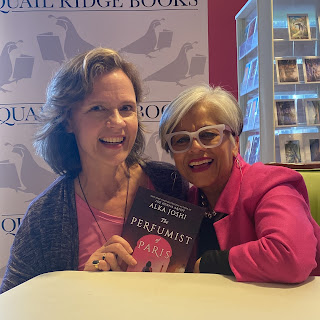
           Meeting Alka Joshi on April 1, 2023
One reason I was able to consume large volumes of text in a short amount of time was because of the audio productions of these novels. I would often be doing chores or running errands while listening to the fantastic vocal performances of these stories. The narrators chosen for these works were excellent, and provided the added benefit of demonstrating correct pronunciations. There are many Indian words and phrases included in The Henna Artist trilogy, and while the included glossaries are quite helpful, I also appreciated hearing unfamiliar terms pronounced by the talented voice actors. 

As an added blessing, I happened to be in Raleigh, NC on April 1st when Alka was making a local appearance at Quail Ridge Books. This also coincided with my 52nd birthday, so it was a special time indeed. I loved meeting Ms. Joshi, and she kindly listened to me as I discussed my worldviews with her. She was so approachable and generous, and it was a pleasure to be in attendance at her event. I expressed my hope for a fourth book in the series, as I envision she will be garnering a whole new audience when the Netflix show premieres. Countless others will be discovering Alka Joshi in the years to come, and I anticipate that they will clamor for more of her work. I will be among them, looking forward to experiencing her India once again.


About the Author


Born in India and raised in the U.S. since she was nine, Alka Joshi has a BA from Stanford University and an MFA from California College of Arts. Joshi's debut novel, The Henna Artist,  immediately became a NYT bestseller, a Reese Witherspoon Bookclub pick, was Longlisted for the Center for Fiction First Novel Prize, & is in development as a TV series. Her second novel, The Secret Keeper of Jaipur (2021), is followed by The Perfumist of Paris (2023). Find her online at www.alkajoshi.com.


Hardcover

Paperback

Kindle

Audio
Hardcover

Paperback

Kindle

Audio
Hardcover

Paperback

Kindle

Audio

Saturday, February 25, 2023

Book Review: The Maid of Ballymacool by Jennifer Deibel

Brianna Kelly was abandoned at Ballymacool House and Boarding School as an infant. She has worked there since she was a wee girl and will likely die there. Despite a sense that she was made for something more, Brianna feels powerless to change her situation, so she consoles herself by exploring the Ballymacool grounds, looking for hidden treasures to add to the secret trove beneath the floorboards of her room.

When Michael Wray, the son of local gentry, is sent to Ballymacool to deal with his unruly cousin, he finds himself drawn to Brianna, immediately and inescapably. There is something about her that feels so . . . familiar. When Brianna finds a piece of silver in the woods, she commits to learning its origins, with the help of Michael. What they discover may change everything.

Fan favorite Jennifer Deibel invites you back to the Emerald Isle in the 1930s for this fresh take on the Cinderella story, complete with a tantalizing mystery, a budding romance, and a chance at redemption.


In Jennifer Deibel’s The Maid of Ballymacool, readers will find elements of the classic Cinderella tale, along with many new components as well. Not the least of these is the simmering theme of Identity which is imbued throughout the narrative. Brianna Kelly inhabits the role of scullery maid in 1930s Ireland, slavishly toiling away in an estate where she is rarely shown any sort of compassion or love. Unlike the fairy tale, however, this story is a work of historical fiction, based partly on chronicled events and/or plausible incidents that are devoid of any kind of special magic. There are no transforming pumpkins or spontaneously-created ball gowns. That said, Brianna shares many common characteristics with Cinderella, as she creates ways to cope with her dire situation with grace and in God’s strength. She also struggles with an inner longing, as she yearns to be more than just an orphaned girl who labors up to twenty hours a day for her room and board. As a young twenty year-old, she makes discoveries about her identity that reach far beyond her wildest dreams. She begins to unearth clues to her clouded history, which include a mysterious connection to a handsome gentleman. This quest not only teaches her about her identity as a woman, but also about how her past will transform her outlook for the future.

The main element which drew this reader in to open the pages of The Maid of Ballymacool was the notion of a Cinderella retelling. This fairy tale/genre was my favorite as a girl, and as an adult I still appreciate the rags-to-riches theme, even if the “riches” are metaphorical. What held my interest as I read Jennifer Deibel’s novel was the quality of writing, character development, and plot execution. While not a riveting spy thriller, the story did maintain an even pace with a likable (and sometimes deliciously detestable) cast. I loved the “winks” to the source material, including lost shoes, an almost-fairy godmother-like character, a handsome gentleman of higher social rank, and a passing mention of “goin’ to a royal ball.”

The Maid of Ballymacool does fall under the umbrella of Christian fiction, as certain elements of that faith are mentioned. Some characters do utter short prayers, and the notion that one’s identity and self-worth can be found in God is raised from time to time. Brianna loves to fellowship with God in nature. Deibel makes her beliefs clear, but they are not shoehorned into the content. The story of Brianna Kelly, Michael Wray, Maureen Magee, and others carries the day. Some adult themes are mentioned, including adultery and some physical abuse endured by a few individuals. However, the details given are minimal and not gratuitous. Any coarse language on the printed page is safe for all ages. The romantic element of the narrative is certainly an important aspect, but the details are sweet and fairly chaste. 

Jennifer Deibel is a new author for this reader, and I very much enjoyed her latest work The Maid of Ballymacool. Lovers of Ireland, Cinderella, early 20th century historical fiction, and even Downton Abbey will find much to recommend in this novel. Much like Cinderella and Brianna Kelly, the search for significance is a common theme in the lives of many. Ultimately our identity will not be found in our job titles, but in who God says we are. As God’s creations we are all of value and worth, and to quote one line from the novel, "Yer purpose in this world has precious little to do with what job ya hold. It's to do wi' the way ya impact the people around ye." 


Read the first chapter of The Maid of Ballymacool here!


About the Author

Jennifer Deibel is the author of A Dance in Donegal (winner of the Kipp Award for Historical Romance) and The Lady of Galway Manor (a Parable Group bestseller). Her work has appeared on (in)courage, on The Better Mom, in Missions Mosaic magazine, and in other publications. With firsthand immersive experience abroad, Jennifer writes stories that help redefine home through the lens of culture, history, and family. After nearly a decade of living in Ireland and Austria, she now lives in Arizona with her husband and their three children. 


WEBSITE | TWITTER | FACEBOOK | INSTAGRAM | GOODREADS


Tuesday, February 7, 2023

Book Review: Not in Want of a Wife by Amanda Kai

What if Darcy and Elizabeth pretended to court?

Mr. Darcy is not in want of a wife. At least, not one that only loves him for his money. Ever since he came of age, Darcy’s been an object of prey to fortune hunters– greedy ladies and their scheming mamas who would do anything to get their hands on his ten thousand a year and his luxurious estate. Tired of being the most eligible man in any room he walks into, Darcy decides the only way to stave off the fortune hunters is to make himself unavailable to them.

Elizabeth Bennet is convinced that only the deepest love could persuade her into matrimony, and since that has yet to appear, she would do anything rather than marry without affection. Unfortunately, all her mother's thoughts are bent on finding rich husbands for her and her sisters. With the arrival of Mr. Bingley and Mr. Darcy causing a stir among all the mothers of Meryton, Elizabeth knows it is only a matter of time before her own mother pushes her to try to capture one of these rich gentlemen for herself at all costs.

Seeing themselves in virtually the same predicament, Mr. Darcy and Elizabeth come up with a convenient arrangement: they will pretend to court while Mr. Darcy is staying at Netherfield. Mr. Darcy will get a reprieve from the relentless husband hunters, and Elizabeth can satisfy her mother with the notion that she has landed a suitor.

But when the time comes for their partnership to end, the feelings that were merely an act have started to become a reality. Will Darcy and Elizabeth find a way to express the feelings that are in their hearts, or will they part ways for good?


There is no shortage of Pride and Prejudice variations, much to the delight of many Janeites who enjoy the exploration of what Austen’s characters might have done if new life choices had been presented to them. Such is the case with Amanda Kai’s speculative work Not in Want of a Wife. In this adaptation, Mr. Darcy and Elizabeth Bennet agree to a fabricated, temporary engagement for purposes that do not include a romantic attachment between each other. While this solves a few problems, it leads to complications due to unexpected developments within their circles of friends and family. Likewise, as is the case in many narratives of this type, the faux lovers are surprised to find a tender regard growing between themselves as well. This produces a collection of issues in need of resolution.

As those issues are addressed, Author Amanda Kai offers a realistic and entertaining tale in Not in Want of a Wife. She is undoubtedly an admirer and respecter of Jane Austen’s source material, as each character remains fairly consistent with the way Austen presented them. Direct and modified quotes from Pride and Prejudice are sprinkled throughout the text, which often brought a smile to this reader. Kai also interjects her own flavors, including material that incorporates none other than the work of William Shakespeare into the story. A Bardian “callback” near the conclusion of the novel was particularly sweet. The complications and resolutions offered are consistently Austenesque in tone, delicious, and very believable in light of the original text. The manner in which all of the plot threads were completed was deftly handled and satisfying. 

For my conservative readership, I can report that Not in Want of a Wife is consistent with the type of content that Austen herself presented. Adult issues are mentioned, but are not highly detailed or gratuitous in nature. Language on the printed page is conservative, with epithets not described directly. The romance level is very sweet and appropriate for all ages. There is one moment of violence, but its presentation is relatively minor and almost humorous. 

This critic has one general quibble with Not in Want of a Wife, and while it is singular, it will inhibit me from offering a rave review. Although Amanda Kai does mention in her Acknowledgements that beta readers assisted her in revising historical inaccuracies throughout the text, I felt that this area and other aspects of the writing sometimes were not very strong. On more than one occasion, 19th century English characters were uttering 20th century American idioms. Other issues of weak grammar were also very distracting. The story itself, its construction, and the nature of the characters were very well done. However, the writing technique left this reader wanting on more than one occasion.

That one criticism may not be a concern for many readers. In fact, some may not even notice the issues I have indicated. The novel is an enjoyable read, with many moments of humor, suspense, and romance. Amanda Kai has written a sweet Austenesque tale that highly respects the source material. At the same time, she has forged her own path in a way that is creative yet honors the world that Austen fashioned. As she continues to hone her skills, I look forward to what this talented author has for her audience next.


About the Author


Amanda Kai’s love of period dramas and classic literature inspires her historical romances and other romances.  She is the author of several stories inspired by Jane Austen, including Not In Want of a Wife, Elizabeth’s Secret Admirer, and Marriage and Ministry.  Prior to becoming an author, Amanda enjoyed a successful career as a professional harpist, and danced ballet for twenty years. When she’s not diving into the realm of her imagination, Amanda lives out her own happily ever after in Texas with her husband and three children. 


Goodreads | Instagram | Facebook


LinkWithin

Related Posts with Thumbnails